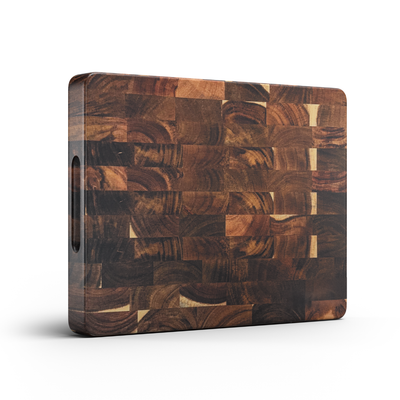
For as long as people have been cutting food, wood has been the surface of choice. It's abundant, easy to work, and soft enough to spare your knife's edge. Here's how to choose a board that will last, and the woods worth buying.
Hardwood vs softwood

Softwood boards are cheaper. Hardwood boards are better, and the difference shows up fast. Hardwood resists scratches and gouges, so it looks good for years instead of months. It's also kinder to your knives: less give under the blade means a cleaner cut and an edge that stays sharp longer.
Porosity
Wood grain comes in three types, and it decides how much moisture the board absorbs:
| Grain | What it means | For a cutting board |
|---|---|---|
| Ring-porous | Large pores in visible rings (oak, ash) | Soaks up juices; harbors bacteria |
| Semi-diffuse | Mixed pore sizes (walnut) | Acceptable with regular oiling |
| Diffuse-porous | Small, even pores (maple, cherry, beech, acacia) | Best. Resists absorption and stains |
If you cut raw meat regularly, this is the spec that matters most. Premium boards are almost always a diffuse-porous hardwood for exactly this reason.
Size and thickness

Bigger is safer. A small board forces you to work around a knife that's too long for it, which is how fingers get cut. The chef's rule: lay your longest knife diagonally across the board and you should have at least an inch of clearance on each side.
Thickness matters too. A thick board resists warping and splitting, repels water better, and is heavy enough to stay put on the counter while you work.
Food safety
If you buy from a reputable maker this is handled for you. If you're building your own board, know that not every wood is safe near food. Some species cause skin irritation or worse. Stick to trees that produce something edible — maple, cherry, walnut — and make sure every glue, oil, and finish is food-grade.
Features worth having

A plain rectangle works. A few additions make it work better:
- Handle or finger grooves — makes a heavy board easy to move and to carry to the table.
- Non-slip feet or a textured underside — keeps the board from sliding mid-cut.
- Juice groove — catches runoff from roasts and ripe fruit before it reaches your counter.
The best woods
| Wood | Hardness | Grain | Notes |
|---|---|---|---|
| Maple | Hard | Diffuse | The classic. Resists bacteria and mold. Use sugar maple, not red |
| Acacia | Hard | Diffuse | Durable, water-resistant, rich color. What we use |
| Teak | Hard | Diffuse | Naturally oily and water-repellent; very low maintenance |
| Beech | Hard | Diffuse | Strong all-rounder; good wear resistance |
| Cherry | Medium-hard | Diffuse | Easy on knives; darkens beautifully with age |
| Walnut | Medium | Semi-diffuse | Slightly softer; dark grain; needs regular oiling |
| Ash | Hard | Ring | Durable but porous; oil often |
| Bamboo | Very hard | — | Technically a grass. Sustainable, doesn't absorb water, but harder on edges |
Maple

The most popular board wood for good reason: dense, durable, naturally resistant to bacteria and mold, and a pale color that fits any kitchen. If you're making your own, use sugar maple — red maple is toxic.
Acacia
Less common than maple but gaining fast. It's hard, diffuse-porous, and naturally water-resistant, with a color that ranges from honey to deep brown within a single board. It's the wood we chose for our knife blocks and our cutting board.
Teak
Naturally oily with a tight grain, teak repels water on its own and asks for almost no upkeep. One of the most hygienic choices available.
Beech
A dependable all-rounder. Diffuse-porous, resists wear and dents, and lasts a very long time.
Cherry
A little softer than maple, so it's gentle on knife edges, and it ages from pink to a deep reddish brown. Easy to care for.
Walnut

The dark, dramatic one. Softer than most board woods, but still durable for years of use. Oil it regularly.
Ash
Hard and light-colored, but ring-porous, so it needs more frequent oiling to keep moisture out.
Bamboo
Not technically wood, but it behaves like one. Very hard, sustainable, and doesn't absorb water. That hardness is the trade-off: bamboo dulls knives faster than the hardwoods above.
Woods to avoid
Oak is a hardwood, but its large open pores soak up moisture and bacteria. Softwoods (pine, fir) dent and split, and the damage transfers to your knives. Exotic species can be toxic; skip anything you can't identify.
The short version
Choose a thick, diffuse-porous hardwood — maple, acacia, teak, beech, or cherry — large enough to clear your chef knife by an inch on each side, with feet or a textured base so it stays put. Oil it every few weeks and it will outlast most of your kitchen.
Ours is an extra-large solid acacia board with room for a full 8" chef knife and clearance to spare.